
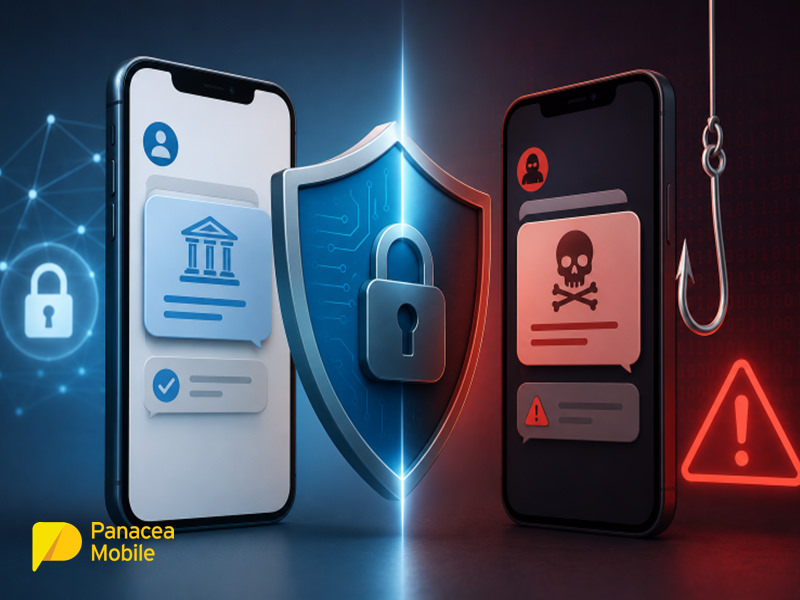
SMS consistently records some of the highest engagement rates of any business messaging channel, with many industry studies placing open rates above 90%. That reach is exactly why smishing and brand impersonation scams have moved onto text messaging.
A spoofed message landing in the same thread as a real bank or retailer rarely gets questioned; it gets acted on. The cost of that split-second trust lands on the brand being impersonated, not the criminal who sent the message, and it shows up as customer churn long after the fraud itself is resolved.
Enterprise SMS security used to mean little more than a spam filter and a terms-of-service clause. That is no longer enough.
Fraud tactics have moved from mass, obviously fake spam toward targeted messages that mimic a brand’s real delivery notices, banking alerts, and one-time PINs almost exactly. Closing that gap takes a combination of internal policy and gateway-level infrastructure, not one or the other.
Key takeaways:
- APWG’s Q1 2026 report shows phishing attacks continuing to rise, while telecom brands and phone-based fraud remain an increasing focus for cybercriminals.
- Spoofed sender IDs and unvetted grey-route aggregators are the two weak points fraudsters exploit most.
- Alpha Tag whitelisting, flash SMS for OTPs, and branded URL structuring close the most common attack paths inside a business.
- Gateway infrastructure, not policy alone, decides whether a brand’s messages stay inside a closed, auditable loop.
How Do Smishing Attacks Compromise Brands?
Smishing works by combining a spoofed sender identity with manufactured urgency, then routing the message through infrastructure that never checks whether it is legitimate. Each weakness reinforces the others.
Spoofing Sender IDs and Alpha Tags
Fraudsters may spoof or imitate sender IDs so fraudulent messages appear to come from a trusted brand. In some cases, messages can even appear within the same conversation thread, depending on how the recipient’s device and network handle sender identification.
Once a phishing text sits alongside genuine delivery notices or SMS-based two-factor authentication codes, most recipients stop checking who actually sent it. GSMA’s guidance on SMS firewalls confirms this is a known network-level weakness, not a rare edge case, and recommends volumetric filtering as a baseline defence.
Why Urgency Tactics Work
Urgency removes the pause where people would normally verify a sender. Messages like “your account has been suspended” or “your delivery failed” are built to trigger an immediate click, not a considered response. Fraudsters reuse the same handful of scripts across industries because they work, which means finance, retail, and logistics brands are often targeted with near-identical wording.
The Grey-Route Infrastructure Gap
Grey-route SMS aggregators route messages through multiple international carriers with little to no vetting, which is exactly what makes them cheap. That same lack of oversight lets spoofed and fraudulent traffic slip through alongside legitimate campaigns, often unnoticed until customers complain. A brand sending through a grey-route provider has limited visibility into which intermediaries actually handled a given message, which makes tracing the source of a spoofed text far slower when an incident does occur.
How Can Enterprises Harden Their SMS Channels?
Four changes close most of the gaps fraudsters rely on: locking down sender identity, protecting one-time codes, adding a verified fallback channel, and standardising links.
- Alpha Tag whitelisting: work with network operators to make sender ID spoofing significantly more difficult on participating networks.
- Flash SMS for OTPs: Class 0 (Flash) SMS displays immediately on screen rather than following the normal inbox flow. On many devices it is not automatically stored, reducing exposure to casual inbox access. (However, behaviour varies between devices and operating systems, so Flash SMS should be viewed as an additional usability and security measure rather than a complete defence against malware or device compromise.)
- Omnichannel fallback: verified WhatsApp Business profiles or app-push notifications carry high-risk alerts, with SMS as the secure fallback rather than the only channel.
- Branded URL structuring: recognisable short domains replace generic link shorteners, which look identical whether they are legitimate or malicious.
Why Does Gateway Infrastructure Matter?
Infrastructure decides whether fraudulent traffic ever reaches a customer’s phone in the first place. A closed, auditable routing path stops far more smishing attempts than any customer-facing policy on its own.
Why Choose Direct Carrier Routing?
Direct routes connect a brand straight to mobile network operators without passing through unvetted third parties, keeping every message inside a closed loop that can be audited end to end. That closed-loop model is what separates providers like Panacea Mobile’s bulk SMS gateway, with direct infrastructure across South Africa, Namibia, and Botswana, from aggregators reselling capacity through grey routes.
What Compliance Rules Apply Locally?
Enterprise SMS security also depends on a provider’s compliance posture, not just its routing. In South Africa, the Information Regulator’s guidance note on direct marketing confirms that POPIA Section 69 requires clear sender identification and an accessible opt-out on every unsolicited electronic communication, including SMS. A gateway with direct relationships with local mobile network operators can also flag unusual traffic spikes before they reach customers.
What Does Real-Time Monitoring Add?
Real-time monitoring turns a gateway from a black box into an auditable system. Instant delivery logs and security alerts let a security team spot anomalies, such as a spike in failed deliveries or duplicate OTP requests, before they become an incident.
| Factor | Direct Carrier Route | Grey Route |
| Traffic path | Closed loop, brand to network operator | Passes through multiple unvetted intermediaries |
| Vetting | Auditable, sender ID protected | Minimal to none |
| Compliance visibility | Aligned with local rules such as POPIA | Often unclear or unverifiable |
| Fraud detection | Real-time monitoring and alerts | Limited to no visibility |
| Cost | Reflects infrastructure investment | Lower, reflects reduced oversight |
The gap between these two models is rarely visible in a pricing sheet, since grey routes are marketed on cost rather than architecture. Enterprises evaluating a new provider can request a walk-through of gateway routing and monitoring before committing to a switch, rather than taking compliance claims at face value.
Frequently Asked Questions
What is smishing?
Smishing is phishing carried out over SMS, usually by spoofing a trusted sender ID and using urgent language to push the recipient toward a malicious link or a request for personal information.
What is a grey route in SMS delivery?
A grey route is an SMS path that moves messages through multiple international intermediaries to cut costs, often without proper vetting of who is sending traffic through the network.
Can flash SMS stop OTP theft?
Flash SMS displays a message directly on screen without saving it to the inbox, which removes the window where malware or a compromised device could scrape a stored one-time PIN.
How does POPIA affect SMS marketing?
POPIA’s Section 69 requires prior consent or an existing customer relationship before sending marketing SMS, along with clear sender identification and an opt-out option on every message.
What should enterprises check before choosing an SMS gateway provider?
Enterprises should confirm whether the provider uses direct carrier routing, holds direct relationships with local mobile network operators, offers real-time delivery monitoring, and complies with local data protection law.
Building an SMS Channel Customers Can Trust
SMS remains the channel with the highest reach an enterprise has, which is exactly why it needs the same scrutiny as any other security-critical system. Sender ID protection, flash OTPs, and verified fallback channels close the gaps fraudsters exploit inside a business. The infrastructure carrying those messages closes the rest. Panacea Mobile provides direct-route SMS gateways across South Africa, Namibia, and Botswana, with real-time monitoring built in.
Businesses ready to review their current setup can get in touch with Panacea Mobile to walk through what a secure, audited SMS channel looks like.