
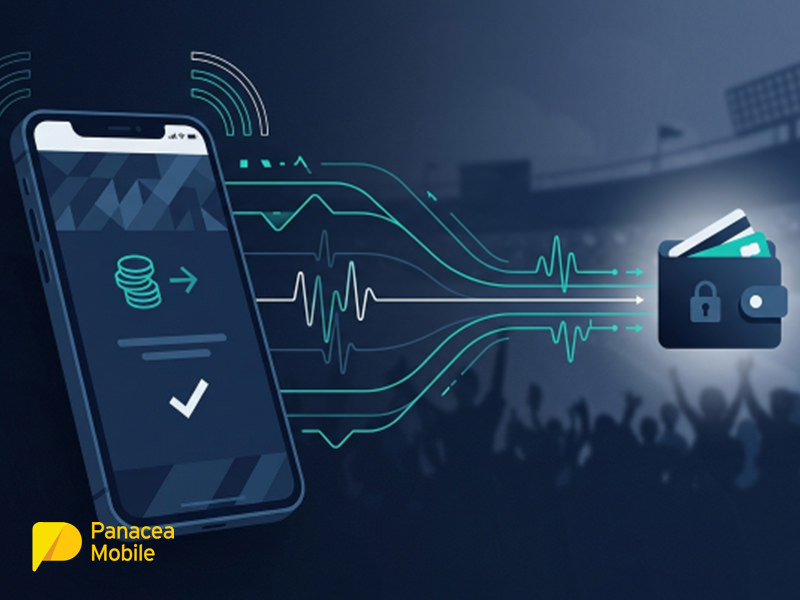
Mobile wallet adoption is accelerating, but the payment link is only as strong as the infrastructure delivering it. In 2026, brands competing for transaction volume during high-intent moments like major sporting events, flash sales, and live commerce need communication rails that are fast, reliable, and built for scale.
This article covers how SMS and USSD fit into the modern wallet trigger workflow, the technical requirements that separate reliable delivery from missed conversions, and how messaging infrastructure providers enable the architecture without owning the wallet layer.
Key takeaways:
- SMS delivers the payment deep-link; the wallet ecosystem (Apple Pay, Google Wallet, etc.) belongs to your platform
- USSD handles secure, session-based authentication for users without mobile data
- Sub-5-second delivery latency is a functional requirement, not a benchmark
- Inbound triggers enable customer-led “reply-to-purchase” workflows at scale
What Is SMS Mobile Wallet Integration?
SMS mobile wallet integration is the practice of using a text message to trigger a payment action typically by delivering a deep link that opens a pre-configured wallet, payment page, or checkout flow directly on the recipient’s handset. The SMS itself does not process the payment. It bridges the gap between user intent and the moment of transaction.
Why Does Delivery Speed Matter for Mobile Payments?
Payment intent has a short half-life. A user who receives a wallet trigger three minutes after their peak engagement window is significantly less likely to convert than one who receives it within seconds. During high-traffic events (a live match, a flash offer, a limited-availability sale), the window between intent and action can be measured in tens of seconds, not minutes.
This is the core constraint that messaging infrastructure must solve. Providers using direct carrier connections and high-priority routing routes consistently outperform those routing through intermediary aggregators, particularly under load.
Read more: Beyond the Password: How A2P SMS Secures Financial Transactions and Fights Fraud
How Does SMS Enable the Wallet Trigger Workflow?
SMS delivers the deep link; the client builds and owns the payment destination. This is a critical distinction that often gets lost in vendor conversations.
The client’s responsibility sits upstream: constructing the secure landing page, configuring the wallet deep link, and managing the payment processor integration. The messaging layer has one narrow but non-negotiable job: get that link to the handset before the intent expires.
Verified Alpha-Sender IDs play a supporting role here. A recognisable sender name increases the likelihood that a user opens and acts on a message containing a financial link. In markets where SMS fraud is a known concern, branded sender IDs directly affect conversion rates on payment-linked messages.
Panacea Mobile operates in this infrastructure layer, delivering payment triggers via its HTTPS SMS API with sub-5-second latency on high-priority routes. The HTTPS API integration supports standard deep-link payloads and bulk dispatch, making it applicable to both single-user transactional flows and large-scale event-driven campaigns.
Read more: The Role of Mobile Messaging in Enhancing Two-Factor Authentication (2FA)
Does USSD Work for Wallet Authentication?
USSD is well-suited to secure, low-friction payment authentication particularly for users operating without mobile data. Unlike SMS, USSD runs over a dedicated signalling channel. The session is encrypted, synchronous, and ends cleanly when the interaction completes.
For mobile wallet workflows, this matters in two scenarios. First, two-factor authentication prompts where the user must confirm a transaction without relying on an app or data connection. Second, markets where smartphone penetration or data affordability creates real access constraints.
A “Push-to-Accept” USSD prompt gives users a structured, session-based interface to authorise a transaction. The flow is controlled, auditable, and compatible across handsets regardless of operating system or data plan.
Panacea’s USSD API supports this authentication pattern with direct USSD server integration, enabling clients to deploy session-based prompts at scale across diverse geographic markets.
Messaging Infrastructure and Mobile Payments: Capabilities Compared
| Capability | SMS (HTTPS/SMPP) | USSD |
| Primary use case | Deep-link delivery, payment triggers | Session-based auth, 2FA, wallet prompts |
| Data requirement | Requires mobile data to open link | No mobile data required |
| Session type | One-way trigger (with inbound option) | Synchronous two-way session |
| Handset compatibility | Broad, OS-dependent for wallet deep-links | 100% compatible, any handset |
| Latency target | Sub-5 seconds (high-priority routes) | Real-time session |
| Ideal context | High-intent moments, flash offers, event commerce | Authentication, emerging markets, low-data environments |
What Are the Real-World Use Cases in 2026?
Flash match offers. A sportsbook dispatches a time-sensitive, personalised offer to a segment of opted-in users at kick-off. Each message contains a unique deep link tied to the user’s pre-configured wallet. The transaction completes before half-time.
In-play top-ups. A user texts a keyword to a short code. The inbound trigger fires an automated response containing a wallet payment link sized to their requested amount. No agent involvement, no app required.
Order-from-seat commerce. Venue operators send SMS-linked checkout flows to ticketholders during events. The link opens a pre-populated cart with delivery to the seat. Payment completes through the wallet already stored on the device.
Each of these requires the same foundation: high-throughput dispatch, reliable delivery confirmation, and a clean deep-link payload that the destination wallet or payment page can resolve instantly.
How Do Delivery Receipts (DLRs) Support Payment Workflows?
Real-time delivery receipts confirm that a message reached the handset while the intent window was still open. For payment-linked messages, this is operationally meaningful, not just a reporting metric.
If a DLR shows delayed or failed delivery, a retry logic can fire before the event window closes. If delivery confirms at scale during a high-volume event, the operations team has live visibility into whether the campaign is performing or stalling. Building DLR feedback into the workflow converts delivery data from a post-campaign report into an active operational signal.
FAQ
Q: Does Panacea Mobile process payments directly? No. Panacea Mobile is a messaging infrastructure provider. It delivers the trigger, the SMS or USSD prompt, that initiates a wallet or payment action. The payment processing layer sits with the client’s payment provider or wallet ecosystem.
Q: Can SMS deep-links work across all mobile wallet providers? Deep link compatibility depends on the wallet provider’s SDK and the client’s integration. Panacea delivers the message payload accurately; the deep-link resolution is managed by the destination app or wallet configuration.
Q: What is a Verified Alpha-Sender ID? An Alpha-Sender ID is a named sender string (e.g., “BRAND”) rather than a numeric short code. Verified IDs are registered with carriers, reducing the risk of messages being filtered or mistaken for spam, a relevant concern when the message contains a financial link.
Q: How does USSD differ from SMS for authentication? SMS authentication typically involves delivering a one-time passcode via text, which the user then enters in an app or browser. USSD authentication creates a direct, session-based interface on the handset itself, requiring no data connection and no app interaction to complete.
Q: Is this infrastructure relevant outside of sporting events? Yes. The architecture applies to any high-intent, time-sensitive transaction context: retail flash sales, ticketing windows, subscription renewals, in-app purchase prompts, and loyalty programme redemptions.
Building Reliable Payment Rails for 2026
Mobile wallet adoption has matured. The bottleneck is no longer whether users have wallets configured; it is whether the trigger reaches them in time, on a channel they trust, with a link that resolves cleanly.
Messaging infrastructure sits at that exact intersection. SMS and USSD do not replace the wallet or the payment processor. They are the connective layer between a brand’s moment of peak engagement and the user’s moment of action.
Providers that operate with direct carrier connections, verified sender infrastructure, and real-time delivery confirmation are positioned to support the transaction velocity that 2026’s event-driven commerce demands. Panacea Mobile participates in this category, offering both SMS and USSD gateway infrastructure designed for high-volume, latency-sensitive deployments.
For teams building or refining their mobile payment communication architecture, the Panacea developer documentation covers HTTPS API configuration and USSD server integration in technical detail.