
A customer requests a verification code, but it arrives after the login window closes. Another starts a balance enquiry and loses the session before an answer appears. Your support team then receives a billing query that takes three different reports to investigate.
These situations affect different people, but they share a practical difficulty. The information needed to explain what happened is spread across several systems.
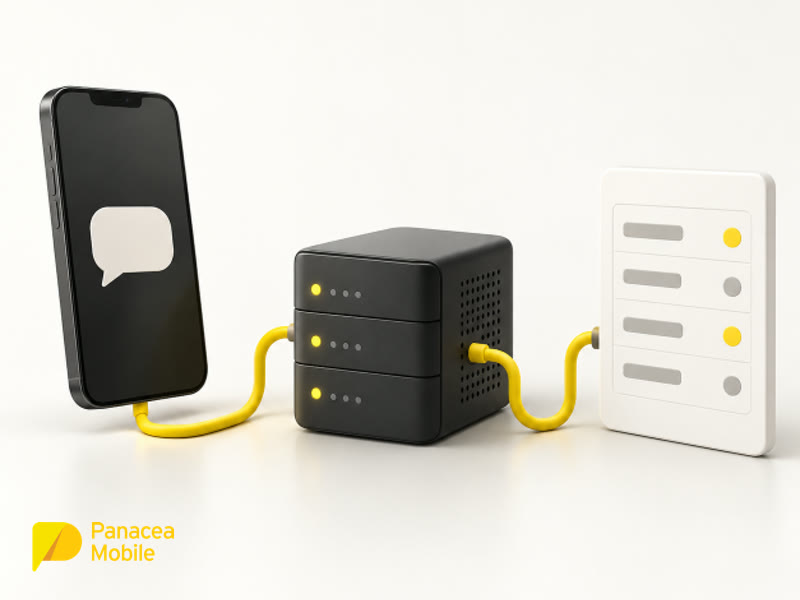
Managing a messaging service means following a task from the customer’s request through to its outcome and associated charge. This article explains how routing, integration and billing contribute to that process and where Panacea Mobile software solutions fit.
Why does messaging become harder to manage as services grow?
Each additional network, supplier and customer account introduces more information to track. A message may pass through an application, a messaging platform, a gateway and a mobile network before reaching the recipient. A USSD enquiry also depends on the business system supplying an answer during the session.
When those systems hold separate records, staff may see only part of the sequence. Support can see that a message was submitted, while operations is investigating a queue, and finance is looking at the resulting charge. None of those records explains the whole event on its own.
A shared reference and a consistent sequence of records help teams connect the stages. The aim is to answer three separate questions: what did the customer request, what happened to it, and how was it charged?
How does SMS routing affect delivery?
A message can be delayed while waiting in a queue or passing through a downstream service. For a verification code, that delay may use up the time available to complete the login.
Routing determines which gateway handles the traffic. Operators can configure that choice using different criteria:
- Priority reflects how traffic should be handled according to the service’s rules.
- Queue size provides information about the traffic waiting at a gateway.
- Least cost selects a route according to price within the configured coverage and routing rules.
These criteria serve different purposes. The cheapest route is not necessarily the quickest, and a smaller queue alone does not establish how quickly a handset will receive a message. Delivery performance needs to be measured across the complete path.
What happens when a request needs to be retried?
If an application receives no response, it may be unclear whether the original request was processed. Repeating it without checking can create duplicate activity or increase the load on a service that is already struggling.
A retry policy sets out which failures justify another attempt, how long to wait and how many attempts to make. Amazon’s guidance on timeouts and retries explains why repeated requests can amplify an outage and why operations with side effects need protection against duplication. These rules belong in the integration design and should be tested before traffic increases.
What does SMPP integration do?
Different applications need a consistent way to submit messages and receive information about them. Without an agreed interface, each connection can involve additional custom handling.
SMPP stands for Short Message Peer-to-Peer. It is a protocol used to exchange SMS traffic between messaging systems. In SMPP integration, several events need to be understood separately:
- Submission is the application handing a message to the messaging server.
- Acceptance means the receiving system has accepted the submission; it does not establish handset delivery.
- Delivery reporting provides subsequent status information about the message.
That distinction helps explain why a successful server response can coexist with a customer still waiting for a code. Protocol support provides the interface. Actual throughput and delivery timing depend on the deployment, queues, connected networks and workload.
Why can a USSD enquiry end before the customer gets an answer?
A USSD interaction takes place within a time-limited session. If a user takes too long to navigate a menu or a connected system responds slowly, the session may time out before the transaction is completed. Time limits vary depending on the mobile network’s configuration and policies. Typically, a USSD session may allow around 20 seconds of inactivity between interactions, with an overall session duration that can start at 3 minutes. Understanding these limits are essential when designing efficient USSD menus and ensuring a smooth user experience.
A balance enquiry typically involves several stages:
- The customer dials a USSD code and selects an option.
- The gateway passes the interaction to the connected application.
- The application requests information from the relevant business system.
- The response returns to the customer through the USSD session.
An integration layer can translate different gateway protocols into a consistent API, giving the application a common interface. That simplifies how the systems communicate. The time taken to retrieve the balance remains a separate part of the process.
What makes the interaction easier to complete?
Short menus and clear options reduce the work the customer needs to do during the session. The application also needs defined behaviour for incorrect answers, slow responses and expired sessions. Panacea’s USSD integration guide explains how menus connect to business systems.
USSD works without using the customer’s mobile data but still needs mobile network coverage. With a zero-rated or reverse-billed service, the business covers the applicable USSD charge. That removes a customer cost barrier; it does not remove session limits or the need for a well-designed menu.
Why should billing be connected to service records?
A charge is difficult to explain when staff cannot identify the activity or tariff behind it. The difficulty increases when supplier costs, customer prices and usage records sit in different systems.
Billing rules define how service activity becomes a charge. Before configuring them, establish:
- The billable event, defined explicitly in the supplier or customer agreement.
- The applicable tariff, including which account, service or destination it relates to.
- The currency, with an agreed process for any exchange-rate treatment.
- The handling of exceptions, including retries, failed activity and adjustments.
Prepaid accounts deduct charges from an available balance, while postpaid accounts accumulate charges for later settlement. Currency-based billing makes monetary amounts explicit, but reconciliation still needs to match usage, tariffs and adjustments. Multi-currency support does not determine those accounting rules automatically.
What information do support, operations and finance need?
When everyone relies on one administrator to investigate an issue, even a routine query can wait unnecessarily. Giving every employee full access creates a different problem by exposing information and controls they may not need.
Access profiles can separate responsibilities. For example:
- Support may need a customer reference and message or session status.
- Operations may need gateway, queue and integration information.
- Finance may need usage, tariff and charge records.
Admin logs provide a record of changes for investigation. Those records also need protection and an agreed retention policy. OWASP’s logging guidance recommends restricting access, protecting logs against alteration and excluding or masking secrets and sensitive information. The deployment needs controls for both finding records and protecting their integrity.
Where do Panacea Mobile software solutions fit?
Panacea’s core software suite covers central service management and additional messaging interfaces. The components have distinct roles within the same environment.
| Component | Documented capabilities |
| Panacea Platform | Central management of SMS, USSD and Push services; routing across multiple SMS gateways; prepaid and postpaid accounts in different currencies; configurable reporting; department-specific admin profiles and searchable admin action logs |
| SMPP Server v3.4 | An SMPP interface supporting outgoing and incoming SMS, delivery receipts, session timeout handling and HTTP callbacks for external routing or accounting logic |
| USSD Box | A standard interface for different USSD gateway protocols, a dashboard campaign builder, tariff and cost records, and configurable country, currency and session settings |
The SMPP Server specification states that throughput is not limited by the licence. Actual capacity still needs to be established for the deployed infrastructure and traffic pattern. Similarly, USSD Box’s country configuration needs to be matched with the relevant operator access and service arrangements.
What should be checked before expanding a service?
Follow a complete customer task through the system, including its charge. Then repeat the exercise under failure conditions.
For a verification journey, trace submission, routing, delivery timing and the billing record. For a USSD enquiry, trace the menu selection, backend response and session outcome. Check the following before launch:
- Can staff connect records across the application, gateway and billing system?
- What happens during traffic bursts, connection failures and delayed responses?
- Can the system distinguish a retry from a new customer request where necessary?
- Are tariffs, adjustments and incident responsibilities documented?
- Does reporting distinguish message delivery from completion of the customer’s task?
These checks help locate the stage that needs attention. A delayed code, an unclear menu and a disputed charge may appear in the same service, but they need different explanations and different corrective actions.
Frequently asked questions
Is a messaging platform the same as an SMS gateway?
A platform manages functions such as accounts, routing, billing and reporting. A gateway provides a connection for exchanging traffic. The platform can manage connections to several gateways.
Does SMPP v3.4 guarantee instant SMS delivery?
No. It defines how messaging systems communicate. Delivery timing also depends on queues, downstream networks and handset availability.
Does multi-currency billing remove reconciliation work?
No. It supports accounts and charges in different currencies. Tariffs, exchange-rate treatment and reconciliation still need agreed processes.
Can a USSD integration fix an abandoned customer journey?
It can simplify the connection between systems. Menu clarity, response times, network availability and the next step still affect completion.
Start by tracing one customer task
Choose a recurring issue and follow the records from the initial request through to its outcome and charge. This gives operations, support and finance a common basis for understanding what happened.
The useful measure of reliability is how consistently the service supports the task and how clearly exceptions can be explained. For teams evaluating the suite, Panacea Mobile can discuss the software against a specific integration and billing workflow.